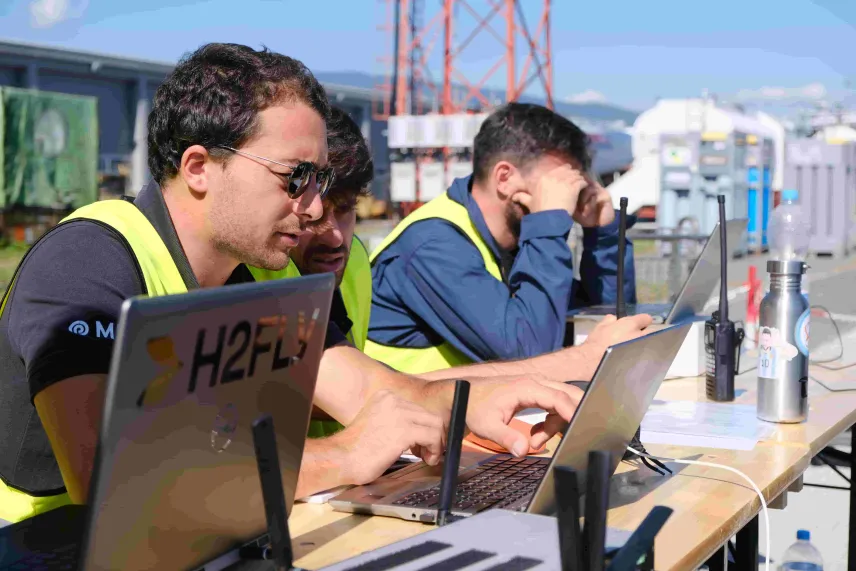
Key facts: H2Fly
- Stuttgart-based developer of hydrogen-electric powertrains for aviation
- Around 75 employees at the time of the interview
- Moving from prototype development towards market-ready product systems
- Recruiting across systems engineering, modelling and simulation, electrical engineering and component development
- Uses an applicant tracking system and automation in recruitment but keeps candidate screening human
One engineer now working successfully at H2Fly could easily have disappeared from the recruitment process before anyone had spoken to him.
He had a relevant engineering degree but had spent several years away from the profession, mainly working in hospitality. For some recruiters this gap would have been enough to put his application to one side. H2Fly saw something worth exploring.
“When we spoke to him we saw strong motivation, we saw curiosity and the right mindset,” says Christina Fretz, HR manager at H2Fly. The company brought him in initially as an intern, giving both sides the chance to see whether the fit was right. He quickly demonstrated his technical capability, integrated well into the team and has now been working there as an engineer for several years.
It is the kind of example Fretz has in mind when she talks about hiring for potential. H2Fly still needs strong technical skills but it also needs to know how someone will respond when they are faced with a problem they have not seen before.
Why H2Fly looks beyond the conventional engineering CV
H2Fly is developing hydrogen-electric propulsion systems with the aim of helping decarbonise aviation. Having demonstrated the feasibility of its technology in flight the company is moving from building prototypes into scaling product development.
This shift changes the type of people it needs. Engineers are working on technologies and components that are still evolving, often without an established guidebook to follow. Fretz says the company needs people who can experiment, adapt and solve problems they may not have been encountered before.
At the same time H2Fly is still a relatively small organisation. People can see the impact of their work directly. With around 75 employees there are fewer layers between an individual and the product they are helping to build. Technical depth is essential but Fretz is also looking for people who can cope with ambiguity, learn quickly and contribute as the company itself changes.
This requirement sits behind H2Fly’s decision not to use AI to screen applicants. AI is already widely used across recruitment, including sourcing, writing job advertisements, matching candidates to vacancies and screening applications. Fretz uses it herself in parts of her HR work. Her concern starts when technology is used to decide who should make it through the first stage.
“We’re often looking for people who have relevant experience, even if they haven’t done exactly the same job before,” she says. “What would concern me most is the talent we’d be missing.”
Her argument is rooted in the kind of work H2Fly needs people to do. A conventional match based heavily on keywords, job titles and familiar career paths may provide useful evidence of previous experience but doesn’t tell you how someone will approach an unfamiliar engineering problem.
As Fretz puts it: “A CV tells you what someone has done, but a conversation tells you how they think.”
How H2Fly assesses potential in practice
Keeping screening human creates another challenge. If previous job titles and experience are only part of the picture recruiters need a credible way of deciding what potential looks like.
H2Fly starts by working closely with engineering leaders to understand the technical requirements of a role and the qualities someone will need as the company develops. Recruitment is active. Alongside advertising roles the company uses sourcing, networking, referrals and direct outreach to identify people who may not be an obvious match on paper.
Once technical competence has been established the process moves further into how candidates think. Fretz is careful about this distinction. “Potential is never instead of technical depth,” she says. “It’s definitely the second question after the competence is established.”
Candidates complete a live technical exercise during the interview process. H2Fly is interested in the eventual answer but the route towards it provides helpful information. Interviewers look at the questions candidates ask, whether they make their assumptions clear, how they respond when they do not know something and how they make decisions when faced with uncertainty.
Candidates also take part in a workshop-style exercise with members of the team. They are given a real challenge without preparing for it in advance. The team can then observe how they structure a problem they have not seen before, how they challenge assumptions, how they communicate their thinking and how they work with other people. “Those situations often tell us much more than a CV ever could,” says Fretz.
The approach has also led H2Fly to speak to candidates who fall well outside the stated requirements for a vacancy. Shortly before our interview the company received an application for a role asking for five years’ experience. The applicant did not have it but something in the CV suggested enough potential for Fretz and the team to start a conversation anyway. At first they thought the candidate might be somebody worth knowing for a future vacancy. Their conversation changed this assessment and H2Fly went on to make an offer.
Watch the In Practice video above to hear Christina Fretz explain why H2Fly keeps AI out of candidate screening and how it assesses potential instead . Read the transcript here
Human judgement still needs structure
There is a cost to working this way. Fretz has been in her role for five years and is open about the fact that H2Fly’s approach takes more time than conventional CV screening.
Looking beyond keywords means reading applications more closely, while assessing potential requires conversations, practical exercises and involvement from people in the business. As recruitment volumes grow the attraction of speeding up that process is easy to understand.
The lesson H2Fly has taken from its experience is that human judgement needs structure. The company uses consistent questions, practical exercises and several perspectives before making a decision. Team members taking part in the on-site workshops are prepared for what they need to assess.
This discipline is particularly important when organisations talk about qualities such as curiosity, adaptability or learning agility. Without a defined process these can become subjective impressions of whether someone feels like a good fit.
“If you’re hiring for potential you need structured interviews,” says Fretz. “We need practical exercises and multiple perspectives in order to make a good decision.”
H2Fly also uses technology to reduce the workload around the parts of recruitment where Fretz sees less need for human judgement. The company has used an applicant tracking system for several years and automates processes where it can. This creates time for the parts she wants people to spend more time on.
“It is definitely harder with our approach and very time consuming,” she says. “So we try to reduce the time wherever possible to have more time for our face-to-face talks.”
Fretz also uses generative AI in her wider HR work, including producing an initial version of job advertisements that she then develops further. Her position is therefore less about whether AI belongs in recruitment and more about where she wants the technology involved in the decision. For H2Fly candidate screening remains on the human side of that line.
When the offer is no longer a pitch
H2Fly reports an offer acceptance rate of 93%. By the time the company makes an offer candidates have already met people they would work with and experienced a challenge drawn from the work itself. They have had a chance to assess H2Fly as well as being assessed by it. As Fretz explains: “By the time we make an offer nobody is surprised on either side. An offer at that point is more a formality than a pitch.”
She believes H2Fly’s size and mission also play a role. Employees can see the effect of their work relatively quickly and understand how their individual objectives contribute to what the company is trying to build. This experience begins during recruitment rather than waiting until someone joins.
H2Fly continues checking the fit after appointment. Fretz looks at retention and has check-ins with new employees after their first month, alongside regular conversations about how people are feeling and where they want to develop. The longer-term view matters because hiring for potential only makes sense if people have room to develop once they arrive.
What HR leaders can take from H2Fly’s approach
- Fretz’s first lesson is to establish competence and then keep looking. Technical capability gives H2Fly the foundation it needs. The next stage is understanding mindset, learning agility and how somebody approaches unfamiliar problems.
- Her second is to spend enough time seeing people think. Conversations, practical exercises and interaction with future colleagues give H2Fly information that previous roles alone cannot provide. For organisations considering a similar approach this also means being clear about what interviewers are assessing and giving them a consistent process for doing it.
- The final lesson is to think beyond the immediate vacancy. Fretz sees recruitment as finding people who can grow with the organisation and want to contribute to where it is going. “The perfect CV doesn’t always become the most successful employee,” she says, “especially in a fast-moving and innovative environment like H2Fly. It’s often the people who can learn, adapt and continuously develop who create the greatest impact.”
About the author