Summary
Giesecke+Devrient (G+D) began exploring AI in 2017 and 2018 through a specialist technology team. As interest and capability grew the company realised that individual use cases would only take it so far. Its focus has since shifted towards scaling AI across the business, bringing business expertise closer to technical capability and paying much more attention to the infrastructure, skills, processes and work redesign needed underneath.
For HR and business leaders the experience offers a useful look at what changes when an organisation moves beyond the pilot stage.
Gabriel von Mitschke-Collande has the sort of AI problem many organisations would like to have. Security technology company Giesecke+Devrient has no shortage of ideas. More than 300 potential AI use cases are sitting in its backlog. The question is what happens next.
Some ideas require data that is not ready while others need technology that is not yet in place. A use case may solve a genuine business problem or turn out to help only a handful of people while some ideas simply do not fit where the company wants to go. What is clear is that every one of them requires people, money and time.
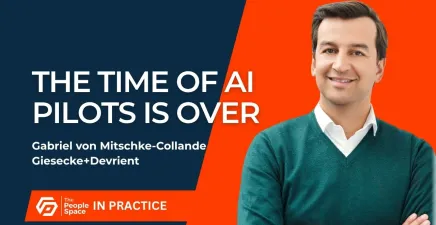
For von Mitschke-Collande, group chief digital officer at G+D, this is why the conversation around AI now needs to move on. “From my perspective the time of pilots is over,” he tells me.
He does not mean companies should stop testing new ideas. G+D is still doing this. Rather his point is that experimentation on its own is no longer enough. AI licences, infrastructure and the computing behind generative AI all cost money. Organisations therefore need a much clearer idea of which problems they are trying to solve and what value will come from solving them.
G+D reached this point after a much longer AI journey than most. The Munich-headquartered family business operates across digital security, financial platforms and currency technology with revenues of about 3.1 billion euros. It began its first AI activity in 2017 and 2018, well before generative AI became an everyday workplace conversation. And it was these early experiments that exposed the limits of leaving AI largely in the hands of technology specialists.
Why G+D moved AI beyond the technology team
G+D's early AI work sat within its tech office where specialist colleagues explored the technology and developed initial use cases. The company learned how AI worked, what it could realistically do and where some of its limitations sat. This approach worked while G+D was still learning what the technology could do but by 2022 the company was facing a different problem.
“We figured out that we need to take different steps forward in order to scale,” says von Mitschke-Collande. “It was not a question of what individual use cases we need to look at. It’s really now a question of how can we scale the usage of this technology and how can we generate value with AI?”
G+D was looking at productivity as well as ways to add AI to existing products and develop new AI-based business. This meant the technical team could no longer work on AI largely on its own. G+D needed people from the business involved too.
So the company changed the way its AI activity was organised. The company is divided into three “segments” and below these are divisions. Each division now has an AI lead who combines knowledge of the technology with expertise in that part of the business. G+D also created a global platform structure spanning AI development, strategy and governance and the IT operation needed to run the tools.
Its AI hub in Montreal grew out of the same thinking. Von Mitschke-Collande and colleagues travelled to Canada several times to look at the AI ecosystems in Montreal, Toronto and Waterloo before choosing Montreal. What appealed was the emphasis on applied AI and the connections between research, commercial development and start-ups. G+D's global head of AI is now based there.
The lesson for other organisations here is why G+D decided to build the hub at all. Once G+D wanted to scale AI it could no longer rely on scattered experiments by people with an interest in the technology but needed people whose job was to connect what AI could do with problems that mattered to the business.
Watch the In Practice video above to hear Gabriel von Mitschke-Collande explain what G+D has learned as it moves from AI experimentation towards scaling the technology across the business. Read the transcript here
Scaling AI means giving employees the chance to use it
Putting the right structure in place still does not mean people will start using AI in their everyday work. People need access to the technology and enough confidence to discover where it helps and where it does not.
This is one of the areas where von Mitschke-Collande repeatedly comes back to trust.
AI feels different from earlier workplace technologies because people interact with it in a much more human way, he argues. They ask it questions, request advice and increasingly allow it to carry out parts of a workflow. This creates uncertainty as well as opportunity and he believes leaders have to be open about both.
“We cannot overcommunicate what we are doing,” he says. Leaders need to explain where they are going, what they know at that point and where uncertainty remains.
This is important when some of the public conversation around AI continues to focus on jobs and replacement. Von Mitschke-Collande says management needs to answer the questions employees raise “in an honest way”.
G+D has also tried to give people practical experience. Employees need access to approved tools so that they can try them in their own work, look at the result and decide whether it is useful or needs to be reworked.
G+D has backed this up with training. It has developed its own learning modules and has worked with an institution close to the Technical University of Munich. HR is now involved with von Mitschke-Collande in developing an AI academy that will support employees and leaders.
This is important to note because plenty of employers are now telling people to use AI without being very clear about which tools they mean or what good use looks like. Von Mitschke-Collande points out that people are exposed to a stream of new consumer AI products in their private lives, yet companies cannot simply adopt every tool that appears.
Enterprise AI brings security, data and governance requirements that consumer use does not. G+D operates in areas such as payments, identity and secure communications, so these concerns are particularly visible but the underlying issue applies much more widely. Employees need to understand which tools they can use at work and what responsible use looks like in that organisation.
Why leaders need to show how they use AI
Von Mitschke-Collande also expects leaders to make their own use of AI visible.
He uses it regularly himself, including to prepare for meetings. He might receive a presentation in advance and use AI to question the document and explore the subject before the meeting. When leaders explain how they are using AI themselves then employees get a much clearer sense of where it might help in their own work.
The same applies further down the organisation. Middle and line managers set priorities for their teams and have an important role in making experimentation feel normal. Von Mitschke-Collande gives the example of someone bringing an AI-supported analysis into a team discussion and explaining the questions the technology raised. “This fosters a culture of AI usage,” he explains, “and this is why I think it's crucial. [Managers and leaders] are multipliers and this helps the AI literacy for an organisation.”
Over time this can make using AI feel like a normal part of the job rather than something separate from it. It also allows questions and concerns to surface closer to the work rather than leaving AI as a subject discussed largely by specialists.
For HR this is one of the harder parts of getting AI used beyond a small group of enthusiasts. An AI academy can provide knowledge and approved tools can provide access. Managers influence whether people actually feel able to experiment and whether they have time and permission to change established ways of working.
The AI 'homework' organisations cannot avoid
The most revealing part of my conversation with von Mitschke-Collande comes when I ask what has proved hardest to develop inside the organisation. He talks first about talent. AI remains a relatively new discipline and companies need people who can build good solutions at sufficient speed. Then he gets into the harder organisational work underneath.
“Often we talk about the magic which is doable with AI,” he says. “But what is also true is that we need to talk about the homework.”
For von Mitschke-Collande much of the homework starts with data. Does the organisation have the data a particular use case needs? Can people access it? If information sits across several systems can those systems work together well enough to support the AI?
Processes create another problem. The current excitement around AI agents rests heavily on the promise that technology will be able to carry out more complete processes rather than simply assist with individual tasks. Yet automation becomes much harder when the process itself is poorly understood.
“If you want to automate processes, we need to have documented and defined processes,” says von Mitschke-Collande.
And sometimes the existing process is precisely what needs to change. Automating one step in a badly designed workflow may achieve very little. G+D is therefore having to think again about process engineering and how work should be organised.
Von Mitschke-Collande says workflow redesign eventually reaches job descriptions because roles change when the work inside them changes. That is a much bigger organisational challenge than buying access to an AI tool. People have established habits and familiar ways of carrying out their jobs. New technology does not automatically change either.
Many HR leaders are already finding this. Giving people an AI tool is relatively straightforward but working out which tasks, processes and roles should change is much harder.
How G+D decides which AI ideas are worth pursuing
Having more than 300 use cases forces G+D to make choices. Von Mitschke-Collande describes this as a positive problem. The company wants people to generate ideas but every proposal still has to survive a practical discussion.
Translation is one example where AI may remove an identifiable cost. Elsewhere G+D looks at measures such as the time taken to complete a process or bring something to market. What matters is being clear about the intended outcome before deciding whether AI is the right way to reach it.
This discipline becomes more important as experimentation gets easier. Generative AI makes it possible for far more employees to imagine and test potential applications. An organisation can quickly end up with more ideas than it has the ability to develop. Then it’s a question of which ones are worth pursuing.
What HR leaders can learn from G+D's AI journey
G+D is a large global technology company working in security-sensitive markets and it started its AI journey earlier than most employers. Other organisations will have different resources and much less technical capability in-house. Even so, some of what G+D has learned is relevant to organisations much earlier in the journey.
The company has reached a stage that many employers are now approaching: it knows AI can do useful things and it has no shortage of experiments. The challenge is getting useful applications beyond individual teams and making them work across the business.
For von Mitschke-Collande this means making AI a genuine organisational priority and deciding what the organisation wants to change before putting technology against the problem. It also means committing the expertise, talent and budget required to follow through.
Once AI starts changing everyday work HR is already involved: people need to learn new skills, managers have to support different ways of working and some roles will change. G+D's experience also suggests that some of the harder AI work begins after a successful pilot. A pilot can show that a tool works. Using it more widely exposes all the other things that have to be in place, from data and systems to skills and redesigned processes.
This is the “homework” von Mitschke-Collande is talking about. The data has to work, processes need to make sense and people need enough understanding and confidence to change how they do their jobs.
Key lessons on scaling AI
- Move beyond collecting pilots. G+D now tests potential AI uses against value, data, technology requirements and strategic fit.
- Give people safe ways to experiment. Access to approved enterprise tools helps employees learn what AI can and cannot do in their own work.
- Bring business knowledge into the AI structure. G+D's divisional AI leads combine technical understanding with domain expertise.
- Expect work redesign to become part of the job. Scaling AI is pushing G+D back into processes, workflows and ultimately the design of roles.
- Treat managers as part of adoption. Leaders help make AI use visible and influence whether teams have permission to change established working habits.
About the author