Summary
Middle management is being blamed for problems created by poor work design.
The role was built for a more predictable workplace where managers passed information down, monitored activity and reported progress back up.
AI, hybrid work and flatter structures are changing the value of the middle, placing more emphasis on sense-making, coaching, judgement, trust and coordination.
A Future Work Forum report argues that organisations need “better middle management, redesigned as leadership in the middle”.
For HR the priority is to redesign promotion, development, career paths and reward so the role matches the work now required
Middle management has become one of the easiest targets in organisational life. When companies want to move faster, cut costs or show they are breaking with bureaucracy attention often turns to the people in the middle. They are accused of slowing decisions, diluting strategy and creating unnecessary layers between senior leaders and the people doing the work.
The argument is one we hear regularly: flatten hierarchy and work will flow more freely, give employees more autonomy and the old supervisory model becomes redundant and use AI and the business case for managers begins to fade.
The difficulty is that this debate often treats middle management as a headcount problem when the more important issue is a work design problem.
The Future Work Forum’s new report The future of middle management argues that the future will be shaped by “better middle management, redesigned as leadership in the middle”, rather than by the disappearance of the middle layer altogether. This is important for HR and business leaders because many of the frustrations associated with middle management are symptoms of a role that has not kept pace with the work around it. Organisations have changed how teams operate, how information flows, how decisions are made and how technology supports work while leaving many assumptions about management broadly intact.
Middle management was designed for a different workplace
For much of the 20th century middle managers had a relatively clear organisational function. They passed information down, monitored activity, allocated work, enforced standards and reported progress back up. The model fitted a workplace where information was scarcer, work was more predictable and authority moved through defined reporting lines.
This world has largely gone. Information now moves instantly through platforms while teams work across functions, borders and time zones. AI can increasingly support scheduling, reporting, summarisation and workflow tracking, and knowledge workers expect context, autonomy and trust, alongside clarity about how their work contributes to the organisation.
Yet many organisations still promote, train and reward managers as though the old model remains the default. Promotion into management is still too often treated as the reward for technical excellence, despite the reality that being a strong expert does not automatically make someone skilled at leading people, navigating conflict or coaching teams.
This is where the design flaw begins. Managers are asked to empower people while being held accountable through control-based measures. They are expected to act as coaches, change agents, wellbeing supporters, performance drivers, digital adopters and culture carriers, often within roles still shaped around supervision and delivery pressure.
The new work of middle management
Middle management is becoming less a fixed layer in the hierarchy and more a set of capabilities the organisation depends on: sense-making, coaching, connection, collaboration design, career guidance, AI interpretation and system stewardship.
Executive, team and breathwork coach Samreen McGregor describes the shift from manager to sense-maker: people who can help teams interpret complexity, regulate pressure and create coherence in uncertain systems. Next Step CEO Jennifer Vessels argues that as AI removes administrative work the human role expands into coaching, judgement, ethics and collaboration. Meanwhile, CEO of Expert Humans Michael Jenkins frames the future manager as a conductor of human and AI contribution, preserving communication and connection across more complex organisational networks.
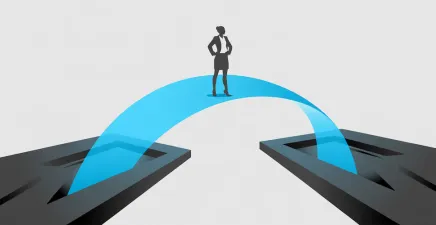
This is a demanding role. It requires people who can hold ambiguity, facilitate difficult conversations, work across boundaries, use data intelligently and help teams make sense of constant change. It also requires commercial understanding. The ideal middle manager is the bridge between financial targets and people’s capabilities, combining people skills, communication, coordination and business know-how.
How AI changes the value of middle managers
AI adds urgency to this conversation because it strips away some of the old visible tasks of management. If a large part of the role was reporting, tracking or passing information between levels then technology can do much of that faster.
What remains is less visible but more human, such as interpreting what data means in context, helping teams use AI with confidence, noticing when automation is creating anxiety or confusion, connecting new tools to real work, and ensuring that technology adoption supports customer value and organisational purpose.
As TR2050 CEO Dominic O’Kelly’s argues: “AI removes much of the administrative burden that once defined line management: reporting, tracking, scheduling, knowledge capture, summarisation. But it also increases the need for human judgment.” This is why the question for leaders should not be how many managers the organisation needs. Instead a better starting point is to ask what human work still needs to happen when digital systems are increasingly shaping coordination, information flow and decision support.
The cost of poor management design
Poor design also helps explain why the emotional cost of middle management is so high. Managers often absorb tensions that senior leaders have not resolved. They are asked to drive productivity and protect wellbeing, create autonomy and ensure consistency, translate strategy and deal with the confusion strategy can create.
The report warns that removing middle management without redesigning work can lead to burnout, fragmentation and cultural deterioration. Organisations cannot simply remove middle management from a hierarchy and expect the system to carry on working. The role of the managers who remain must change and more responsibility must move to the frontline in a deliberate, supported way.
What HR leaders should redesign first
Leaders need to recognise that not everyone should become a manager and that selection should be based on the skills needed to lead and motivate teams today, including communication, empathy and the ability to support others.
Career paths also need attention. If management remains the main route to status and reward then organisations will keep pushing experts into people leadership regardless of appetite or aptitude. The report points to dual career paths, where technical excellence and people leadership are valued at equivalent levels, as one way forward.
Development must move closer to the real work. Graham Wilson, author of The New Leadership Manifesto, argues that the future of leadership will be “won or lost in the middle” yet this group is often neglected while investment flows to the c-suite and early-career talent. Future-fit middle managers need resilience, systems thinking, coaching capability, change confidence and digital curiosity, developed through practice, peer learning, mentoring and live business challenges.
Reward must then follow. If middle managers are valued mainly for team size, budget or positional authority the work of building trust, reducing friction, accelerating learning and creating clarity will remain undervalued.
Three questions for HR leaders
- What work is currently carried out by middle managers that would still need to happen if the layer was reduced?
Look for translation, coaching, conflict resolution, workload management, AI adoption, psychological safety and cross-functional coordination.
- Are people being promoted into management for the right reasons?
Technical credibility matters but people leadership now requires coaching, empathy, communication, systems thinking and business judgement.
- Are development and reward systems aligned with the future role?
If managers are expected to build trust, accelerate learning and make complexity understandable then these contributions need to be developed, measured and recognised.
The future of middle management starts with work design
The debate has moved beyond whether middle management should survive, and instead leaders should look at the system around the role: promotion, development, career paths, AI adoption, reward and measures of value.
Middle managers have carried the blame for many organisational frustrations, and poor management undoubtedly damages trust, performance and engagement. Yet blaming the layer alone misses the deeper issue: organisations have changed the demands of management without redesigning the role to match.
The middle management crisis is a work design failure. To fix it we need to ask what the organisation now needs from the middle – and how should the role be designed so that people can deliver it?
About the author