Key facts: Sapiens International
- Global software provider focused on the insurance industry
- More than 600 insurer customers across over 30 countries
- AI is increasingly embedded in both its products and internal ways of working
- AI access is being rolled out in cohorts rather than to the whole workforce at once
- Sapiens is recruiting a cohort of 30 younger employees
- The company is developing the Sapiens Brain to bring product, technology, process and organisational knowledge together
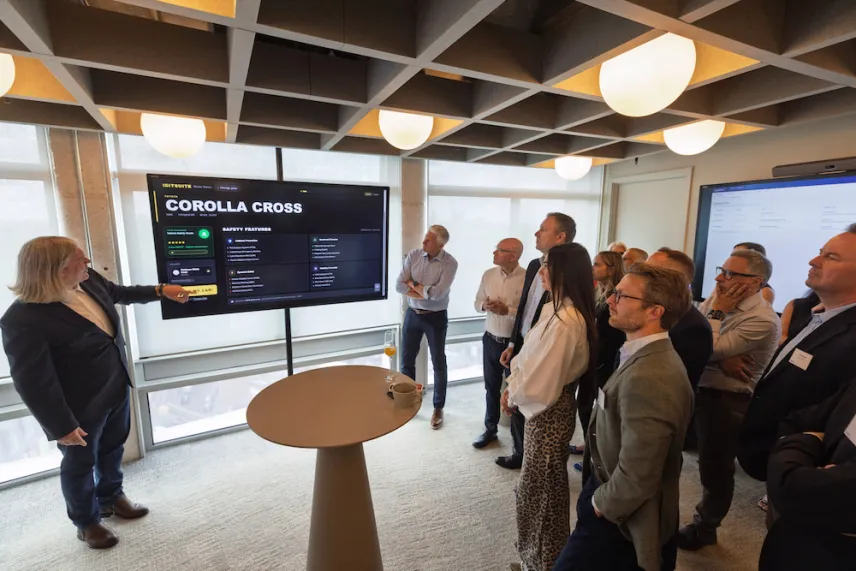
At a recent Sapiens offsite chief people officer Ernesto Marinelli gave employees three case studies to work through. All were linked to the transformation taking place inside the insurance software company.
He was interested in the answers but even more interested in how people got there. “What kind of discussions were triggered? How were they judging the situation itself? The reflection back for me was less important as the aspect of understanding how they are judging what is happening.”
The exercise forms part of an idea he is starting to develop more formally: a “judgement gymnasium” in which people can practise working through situations that reflect the real decisions they face at work.
For Marinelli this is becoming more important as AI changes the relationship between knowledge, experience and performance. If information becomes easier to generate and retrieve, he argues, advantage increasingly lies in knowing what to trust, what fits the context and what to do next.
“Judgement in the past was important. Today it will become even more important and even a competitive advantage.”
Why judgement is moving up the talent agenda
When Marinelli was asked to help prepare the workforce for AI his first step was simply to use it. What struck him was the abundance of information it created. Work that previously required research, expertise or time could suddenly be accelerated. He recalls writing his PhD many years ago and the effort involved in researching and drafting it. Today, he says, AI could have cut that work substantially.
This changes the value of learning agility in his view. He does not argue that learning stops mattering but rather than some learning becomes embedded in the work itself because employees can question an AI tool, refine an answer and explore a problem as they go.
The key, though, is what happens next. “You have to judge: is this outcome what I wanted to achieve or not?” he says.
Marinelli calls this “judgement velocity”: the ability to understand a situation, assess what AI produces and decide quickly whether it fits the context. It’s an interesting take, as HR has spent years identifying qualities such as learning agility and high potential. Marinelli believes these still matter but may become less distinctive when everybody has easier access to information and support.
Testing judgement in recruitment
This thinking is starting to influence recruitment at Sapiens. Marinelli says candidates can be given a situation and asked what they would do. The point is not simply to see whether they reach the preferred answer but for recruiters to be able to observe how quickly they understand the context, what they pay attention to and how they reason their way through it.
Then there is the challenge of developing judgement once people join. Marinelli is exploring what he calls a “judgement gymnasium”: an environment where employees repeatedly work through situations and practise deciding what matters.
His inspiration comes partly from business-school case studies. A well-designed case gives somebody a context, competing information and a decision to make. AI, he believes, could make that approach much more dynamic by creating fresh scenarios linked to what is happening in the organisation at the time.
Sapiens has already started testing the principle. At the offsite Marinelli gave employees three case studies related to the company’s transformation and watched how they discussed the issues and reached their decisions.
The judgement gymnasium itself is still an idea in development. But the offsite experiment reflects a broader shift away from assuming that judgement develops simply through time served.
The judgement gymnasium
Marinelli’s idea is to create a repeatable way for employees to practise judgement using realistic business situations. Rather than being assessed only on the final answer people would work through context, competing information and possible consequences. AI could eventually help generate fresh scenarios linked to current organisational challenges.
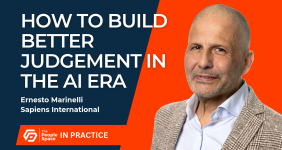
Watch the In Practice video above to discover how Ernesto Marinelli views building better judgement in the AI era and to read the transcript of the video
The experience problem for younger workers
The question becomes particularly interesting when it comes to younger employees. Sapiens is in the process of recruiting a cohort of 30 young people. Marinelli does not assume that being comfortable with AI automatically makes them better prepared for an AI-enabled workplace. Judgement takes time.
“I am now an older man and of course I judge things potentially differently from when I was 25,” he says.
At the same time younger employees may bring something experienced colleagues do not. Marinelli sees them using AI more naturally as part of everyday work, while people of his generation are often still learning how to embed it into their routines.
He describes himself experimenting with agents to help structure his day and respond to email. Younger employees, he says, are often more comfortable treating prompting and AI assistance as part of the normal way work gets done.
This creates a two-way exchange: younger workers can bring greater AI fluency while more experienced colleagues help them build the contextual judgement that comes from having seen situations play out before.
Peer learning matters in this model. Marinelli does not see judgement as something that necessarily requires everyone to be in the same room. Instead what matters is exposing people to how others think, question and interpret situations.
Building a ‘Sapiens Brain’
The same thinking is shaping how Sapiens handles organisational knowledge. The company is developing what it calls the Sapiens Brain: a repository bringing together knowledge about products, technology, historic tickets and internal processes.
For an account executive, for example, this could mean that a customer asking about a piece of functionality can get a quicker and more useful answer. Previously the account executive may have needed to contact product management, check what was already being developed and wait for several people to respond. Bringing more of that knowledge together allows employees to find information faster and respond with a broader view of what already exists across the organisation.
Marinelli sees this as part of a wider move away from knowledge sitting inside separate functions or with individual specialists. His ambition is to create what he calls a “collective brain”, combining people, organisational knowledge and AI.
This changes the way work is organised. Marinelli argues that increasingly complex problems are harder for one function to solve in isolation. Finance, HR, sales or technology each see only part of the picture. Collaboration therefore becomes, in his words, “infrastructure”.
The shift Marinelli is watching
From: knowledge sitting with individual specialists and functions
Towards: shared organisational knowledge, cross-functional problem solving and people working alongside AI
When recognition follows the work
This shift is beginning to show up in recognition and reward. Sapiens has introduced quarterly programmes recognising customer champions and innovation. Marinelli says the winning contribution is often made by a small team rather than one individual.
Collective achievement is also reflected in bonus arrangements. There is still room for individual recognition – Sapiens has an “AI Maverick” programme for employees who are helping others understand and use AI. But Marinelli’s broader point is that organisations may need to examine people systems built heavily around individual performance if more value is being created collectively.
What Sapiens has learnt about AI adoption
Sapiens has not simply switched AI on for everyone. The company is rolling access out through cohorts, beginning with groups using AI to build agents for customer-related work and learning from each stage before expanding further.
One early assumption has already changed. Marinelli expected that giving employees access would encourage them to start experimenting. It did not.
“There are a lot of people that are not even using it without even trying it,” he says. “Sometimes you think that just giving the opportunity to people to use it means people adopt it. This is the wrong assumption.”
His lesson is to give people a reason to use the technology. A specific task or objective gives them something concrete against which to judge whether it helps and allows trust to develop through experience.
His own use has evolved too. Marinelli says he originally assumed AI might involve prompting a tool, receiving an answer and using the output. Instead he increasingly challenges what comes back. He sometimes uses more than one model or asks the technology to look at an issue from a different professional perspective. If he is working on something with legal implications he may ask how a major law firm might react. If it is strategy he might ask how a consulting partner would challenge it.
The AI gives him another view but he judges whether that view is useful.
Rethinking workforce planning
Marinelli expects the implications to reach further into workforce planning. As Sapiens expands AI use the company will eventually need to understand the return it is getting and how human capacity sits alongside the cost and capability of AI.
He describes the future question as how organisations manage “headcount and tokens together combined”.
It may require a different starting point for workforce planning. Instead of looking only at how many people are required to perform a volume of work organisations will need to understand which capabilities should sit with people, which can be handled by machines and where the combination creates most value.
For Marinelli this is still emerging territory. “Everything that was how we did workforce planning, we can throw it away and reinvent it now from scratch,” he says
What HR leaders can take from Sapiens’ approach
Sapiens is still experimenting and Marinelli makes no claim to have a finished model. But one lesson so far is that AI literacy on its own is not enough. Employees also need to be able to interrogate what the technology produces and understand when an answer fits the situation in front of them.
The second is that judgement can be made more visible. Recruitment scenarios and case-based exercises give organisations a way to see how people interpret context rather than simply measuring what they know.
There is also a development challenge. If younger employees bring greater fluency with AI while experienced colleagues bring knowledge built through years of exposure, organisations need ways for those capabilities to meet.
And Sapiens’ experience suggests access alone will not create adoption. People need a practical reason to experiment with AI and an opportunity to see where it helps, where it does not and when they need to challenge it.
For Marinelli this uncertainty is part of the opportunity. “It’s a time of experimenting,” he says. “It’s a time of trying to write a new book about how we work.”
About the author