Summary: What is the Work Reality Gap?
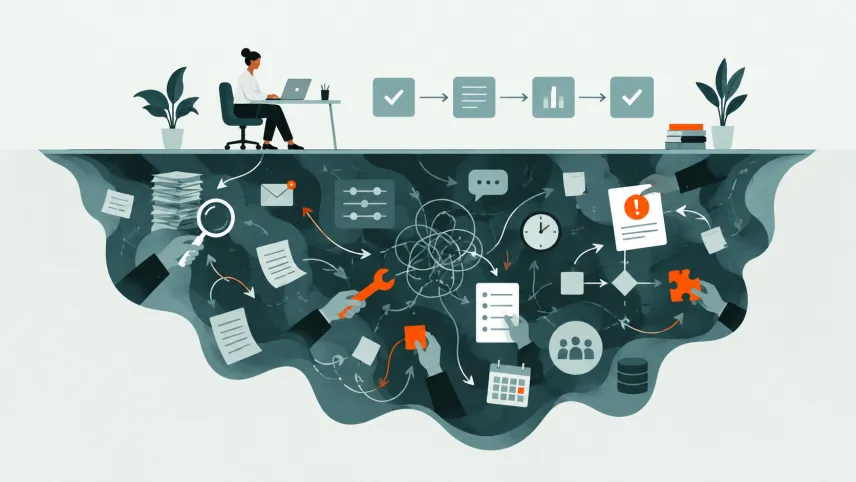
- The Work Reality Gap is the distance between how work is designed, described or measured and what people actually experience when they do it.
- It appears when hidden work such as checking, coordination, workarounds and judgement is missing from formal processes or productivity measures.
- The People Space uses the idea to examine how work really happens and where leaders may be making decisions based on an incomplete picture.
At The People Space we use the term Work Reality Gap to describe what happens when the formal version of work and the experience of doing it start to drift apart. A system may save time in one part of a job while creating more checking somewhere else. A role that looks perfectly manageable on paper may depend on somebody constantly dealing with exceptions that were never designed into it.
This has always happened at work but AI is making some of it easier to see because technology can speed up one part of a task so dramatically that the rest of the effort is easy to overlook. The Work Reality Gap gives us a way of looking at the whole job rather than only the part that has become faster.
Why does the Work Reality Gap happen?
Organisations usually describe work through the structures around it: the process people are meant to follow, the responsibilities attached to a role and the measures used to judge whether something has been delivered. The working day rarely fits these structures quite as cleanly.
People end up doing whatever is needed to get the work done, often without thinking of it as extra work at all. For example, information that should be easy to find takes longer than expected, a policy does not quite fit the situation or a system needs a workaround, so people sort it out and move on. Because the work gets done the effort involved can remain largely invisible.
This is how an organisation can believe a process is working well while employees are doing a great deal to keep it working under the radar.
AI is making the gap easier to see
AI provides a particularly clear example because speed is so easy to measure. Microsoft Research found in a six-month randomised field experiment involving 6,000 workers that people with access to generative AI spent less time on email and appeared to complete documents somewhat faster. Activities that depended more heavily on coordination with other people changed much less.
Anyone using generative AI regularly will recognise why this distinction matters. Producing the first version can be extraordinarily quick. Deciding whether it is right can take much longer. What looks finished may still need to be checked against the source material, adapted to the situation or rebuilt if the machine has misunderstood the task.
Another Microsoft study, based on 319 knowledge workers and 936 examples of generative AI use, found that critical thinking was moving towards checking information, integrating AI responses and overseeing the task. Higher confidence in the AI was also associated with people reporting less critical-thinking effort.
The researchers are not saying that AI is making people less capable but their findings show how the human contribution can shift towards checking and oversight even while the task itself appears to become faster.
The People Space is exploring this in a separate feature on what happens when AI takes more of the producing and leaves people with more of the checking. AI promised to remove the boring work. It may be creating more of it.
Productivity measures can miss the work around the work
This becomes particularly important when organisations try to measure productivity. If somebody produces a report in 20 minutes rather than two hours the saving is obvious. It becomes much harder to judge when a colleague then has to spend time working out whether the analysis is sound or turning it into something they can use.
This is one reason productivity can look impressive at task level without changing very much across the organisation. OECD research reflects the same complexity. Workers often report better performance and greater enjoyment from AI, while case studies also find greater work intensity and examples of jobs being reorganised in ways that leave some tasks more tedious or less interesting.
The gap can change the quality of a job
Some of the satisfaction of work comes from working with a problem long enough to understand it and eventually producing something you feel some ownership of. This is also how people learn. Repeated experience gradually builds the judgement you draw on later, particularly when something does not behave as expected.
This becomes more interesting when organisations start deciding which parts of a job AI should take over. Routine work is often the obvious place to begin and sometimes there is every reason to automate it. Repetitive tasks can be exhausting or simply a poor use of somebody’s time. But routine work can also be where people learn how the job works under normal conditions before they are expected to handle the unusual ones.
If automation leaves somebody dealing mainly with exceptions or checking work produced elsewhere they may have fewer opportunities to practise the underlying task themselves. The person remains responsible for spotting when something is wrong while spending less time doing the work that taught them how to recognise it.
Managers often live in the gap
Managers are often the people who discover how far the formal version of work has drifted from what happens in practice. A large part of the job can involve making organisational decisions workable for the people who have to carry them out. When responsibilities overlap or priorities conflict somebody still has to decide what happens next and that person is often the manager.
New technology can add more of this work. Once a system is introduced problems start appearing that were difficult to anticipate in the business case and managers find themselves helping people work out where the technology fits, when it should be trusted and what to do when it does not behave as expected. Very little of this tends to appear in the calculation of how much time the new system is meant to save.
This is also why conventional measures of managerial workload can miss so much. Two managers may have the same number of direct reports and formally similar responsibilities while one spends a much larger part of the week sorting out problems created elsewhere in the organisation.
A related People Space article by organisational psychologist Dr Liane Davey describes this as part of the growing “thoughtload” around AI: the cognitive and emotional burden involved in prompting, checking, integrating and remaining accountable for work produced with technology. Why AI will not fix productivity until managers reduce ‘thoughtload’.
Why employee voice does not always reveal the whole picture
Engagement surveys and listening exercises can tell organisations a great deal about how people feel about work. They are less good, though, at showing what happens during the working day. Someone may say their workload is manageable and still spend a surprising amount of time finding information that should have been easy to locate or reworking something because responsibility was unclear.
People also get used to friction very quickly. A workaround that started as a temporary fix can become so ordinary that nobody thinks to mention it. Asking someone to describe how a recent piece of work got done can therefore reveal things that a broad question about workload or employee experience never reaches.
How do you know if there is a Work Reality Gap?
- Where does work routinely take longer than the process says it should?
- What do people do that rarely appears in their job description?
- When technology saves time, where does that time actually go?
- Which parts of the job help people build the judgement they need later?
- What happens when the standard process fails?
Ask these questions about recent examples rather than as an abstract diagnostic exercise.
Closing the Work Reality Gap starts with seeing it
There will always be some distance between organisational design and working reality. No policy, system or job description can anticipate every situation. The problem comes when that distance becomes large enough to shape decisions based on a version of work that employees no longer recognise.
The practical starting point is to look at work from the point of view of the person doing it and ask where their time really goes, what they routinely have to work around and what has changed in the job that formal measures may have missed.
At The People Space the Work Reality Gap is our way of examining these questions. As work changes, we will use this page to bring together reporting, research and practical examples of what happens when organisational assumptions meet everyday working reality.
Frequently asked questions: The Work Reality Gap?
What is the Work Reality Gap?
The Work Reality Gap is the distance between how work is designed, described or measured and what people actually experience when they do it.
Is the Work Reality Gap mainly about AI?
No. AI is making some gaps easier to see because it can change where effort sits in a job. The same idea applies to management, productivity, hybrid work, job design and employee experience.
Why should HR pay attention to the Work Reality Gap?
Because HR helps shape jobs, technology, management and skills. If the formal version of work no longer matches what people actually do, decisions about productivity, capability and employee experience may be based on an incomplete picture.
About the author