Summary
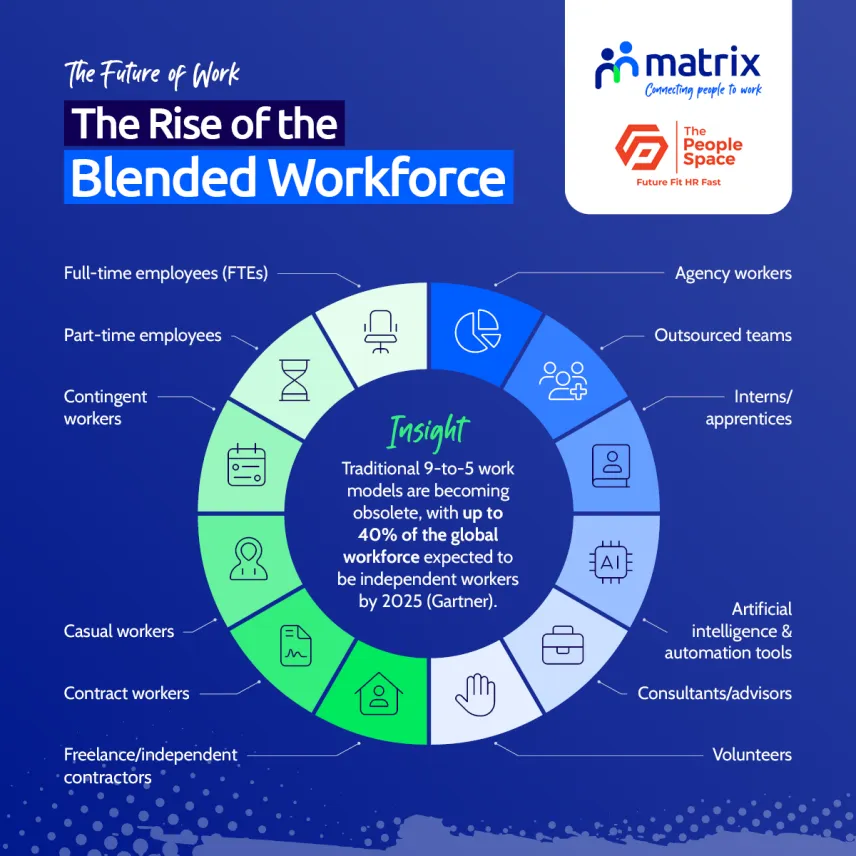
A blended workforce integrates permanent employees, contingent workers and AI into a single workforce system designed around capability rather than headcount. Research from Matrix and The People Space shows that redesigning work in this way enables productivity gains, access to scarce skills and more sustainable performance without increasing permanent headcount.
What is a blended workforce?
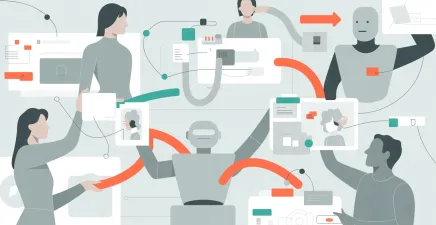
A blended workforce brings together permanent employees, contingent workers, freelancers and AI as part of one coherent workforce model. Rather than treating non-permanent talent and technology as temporary add-ons, organisations design work around the full ecosystem of capability available to them.
This approach allows work to flow to the right mix of human judgement, specialist expertise and automation at the point it is needed.
Why the workforce model must change
Productivity has stalled across advanced economies while labour markets have tightened. Skills shortages persist, hiring has become slower and more expensive, and burnout now affects a large proportion of the workforce. Demographic decline is shrinking the pool of available talent in many regions, making permanent headcount an increasingly fragile lever for growth.
Evidence shows that productivity improves when work itself is redesigned. Yet many organisations still plan work primarily through the lens of permanent roles and job titles. This disconnect limits access to skills, increases pressure on existing employees and constrains organisational resilience.
A blended workforce addresses these structural constraints by extending organisational capacity without adding long-term headcount. Contingent talent provides specialist skills on demand. AI adds scale and speed at relatively low cost. Together, they enable new ways of organising work that traditional models cannot support.
The four levers of a resilient blended workforce
Research from Matrix and The People Space identifies four levers HR must prioritise when building a blended workforce.
Design
Workforce planning must integrate permanent, contingent, freelance and AI capability within a single system. This allows organisations to balance cost, risk, skills and outcomes more effectively.
Compliance
Strong governance enables scale. When compliance frameworks are clear and proportionate, organisations can access broader talent pools with confidence rather than caution.
Culture
Stigma around contingent talent restricts performance. When all contributors are treated as part of the same mission, engagement increases and execution accelerates.
AI integration
AI should be treated as part of the workforce. HR must plan for the tasks AI performs, the skills it augments and the decisions it influences, rather than viewing it solely as a productivity tool.
Together, these levers shift HR from process management towards workforce architecture.
What HR must do next
HR now holds greater strategic influence than at any point in recent decades. To realise the benefits of a blended workforce, that influence needs to be directed towards workforce design.
This means:
- leading the creation of blended workforce models that integrate human and AI contribution
- reframing the HR business partner role towards evidence-based advice on workforce composition
- educating leaders to move conversations from headcount to capability
- acting on data from contingent and AI work in the same way employee data is used today
Managers also need support to lead through change with clarity and dialogue so teams can sustain performance as work is redesigned.
The cost of inaction
If workforce models remain unchanged, organisations face rising costs, widening skills gaps and continued productivity stagnation. The gains leaders seek will not come from longer hours. They will come from workforce architecture that blends the strengths of permanent staff, contingent talent and AI in ways that are guided by evidence and enabled by confident managers.
The blended workforce will not mature by accident. HR has a decisive role in shaping it.
Download the executive briefing
Solving the productivity crisis with a blended workforce
An executive briefing from Matrix and The People Space exploring workforce design, AI integration and productivity through a blended workforce lens (no registration required).
What is a blended workforce?
A blended workforce integrates permanent employees, contingent workers, freelancers and AI into a single workforce model designed around capability rather than job titles or headcount.
How does AI fit into a blended workforce?
AI is treated as a workforce participant. HR plans for the tasks AI performs, the skills it augments and the decisions it influences alongside human contributors.
Why does a blended workforce improve productivity?
By redesigning work around capability, organisations reduce bottlenecks, access scarce skills faster and relieve pressure on permanent staff, enabling more sustainable performance.
Is a blended workforce only relevant to large organisations?
No. Any organisation facing skills shortages, cost pressure or productivity challenges can benefit from designing work around blended capability rather than permanent hiring alone.
About the author