Summary
- Generative AI can save time on individual tasks without making the overall job more creative, satisfying or less demanding.
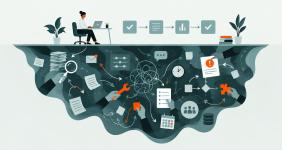
- As AI takes on more production work people can spend more of their time checking outputs, exercising judgement and deciding whether machine-generated work can be trusted.
- Routine work often plays a hidden role in building professional expertise. Removing too much of it can weaken the way less experienced employees learn to recognise mistakes and make sound judgements.
- The real impact of AI depends on what happens to the work that remains. The People Space’s Work Reality Gap highlights the difference between a task becoming faster and a job becoming better.
I’ve always been nosy. As a child I apparently spent car journeys with my head between the front seats asking my parents questions, so perhaps journalism was inevitable. I like finding things out. Increasingly, though, I spend a surprising amount of my working life finding out whether somebody, or something, has made them up.
Checking has always been part of journalism. You verify a statistic, go back to the original research and question a quotation that sounds just a little too convenient for the argument being made. Generative AI has changed the volume and speed of this work. I now receive supposedly finished material and can spend considerably longer tracing the original study or establishing whether a quoted expert really said those words than it took to produce the copy in the first place.
AI can deliver a credible first draft in seconds and summarise a long report before you have finished making a cup of tea. I use it almost every day. It has become something close to the editorial assistant I no longer have and is particularly useful for work such as repurposing material for social media. Yet parts of my job have also become noticeably duller as more of my time shifts towards checking what has been produced so quickly.
This experience has made me interested in a larger question. We have spent several years hearing that AI will absorb routine work and release people for something more ‘creative’ or ‘valuable’. But what really happens to the job once these routine tasks have disappeared?
It is one version of what we at The People Space call the Work Reality Gap: the distance between how work is designed, described or measured and what people experience when they do it. AI can save considerable time on one task while leaving people with a very different working day at the end.
When did checking become the higher-value work?
Microsoft researchers Hao-Ping Lee, Advait Sarkar, Lev Tankelevitch and colleagues studied 319 knowledge workers and 936 real-world examples of generative AI use. They found that AI did not simply remove thinking but changed where that thinking happened, with more effort shifting towards verifying information, integrating AI responses and overseeing the task. Higher confidence in AI was also associated with less critical-thinking effort.
Business psychologist Andrew Whyatt-Sames sees something similar inside his own highly AI-enabled business. His team built an AI operating system that now handles a substantial amount of execution and allows them to work at a pace he says would previously have been impossible.
What has changed is the constraint. “Before, we used to run out of time,” he tells me. “That’s not the problem anymore. You run out of energy.” His team now talks much more openly about burnout because so much of their working day can involve judgement.
Whyatt-Sames describes his own AI-assisted work as “applied critical thinking all day, every day. Everything is a dynamic risk assessment.” He may use several models to research the same question, compare their answers, look for discrepancies and investigate the remaining uncertainty himself.
Whyatt-Sames’ “dynamic risk assessment” is what constant checking looks like at scale. Joanna Griffin, head of people and safety at American Golf, gives a much smaller example of why it is needed. She uses Claude as a kind of chief of staff and one day it suddenly started calling her Alex. When she challenged it the system explained that it could no longer see where her name had appeared earlier in the conversation. Rather than leave the information blank it had supplied one. “It filled the gap without me asking it to,” she says.
The wrong name may be funny but it raises an important point: when information is missing the system produces something plausible anyway. This is exactly the sort of thing an experienced user learns to look for.
Sustained judgement is cognitively demanding. Removing the legwork does not necessarily make the job easier and it certainly does not tell us whether the work left behind is any more satisfying.
What happens to the hour you save?
HSBC’s 2024 Digital Horizons predicted that successful companies will increasingly resemble “research labs, places devoted to creativity.” Executive coach Emma Steenson went into her MSc research at Henley Business School sceptical of precisely this promise: that AI would clear away routine work and leave professionals with more time to think.
She interviewed 12 practising lawyers who had been using generative AI at work for at least six months. Everyone told her it was saving time but what differed was what happened next.
In some transactional areas of law the answer was simply more work. People got through more cases or completed more tasks in the same working day. Others had enough control over their work to spend longer thinking through a problem or testing an idea. One participant worked somewhere that had deliberately decided to use the capacity released by AI to create more thinking time, an approach Steenson says was unusual among those she interviewed.
Her view shifted as a result. She could see that AI could give some professionals more room for creative thought, but only where people were able to use the time differently. Where faster working simply became an opportunity to increase output she puts it more bluntly: “You’ve just compressed the boring jobs. And now you’re doing more of it.”
What do we mean by creative work?
Creativity at work does not just mean writing, designing or producing something artistic. One definition used in research informing executive coach Emma Steenson’s study describes it as developing new and useful ideas, individually or with other people. Innovation is what happens when these ideas are put into practice.
In everyday work this can mean thinking through an unfamiliar problem, testing an idea or finding a better way of doing something. Steenson’s lawyers described using some of the capacity released by AI to explore ideas and reason more deeply.
Operations and technology consultant Matthew Wolff Simon points to a broader assumption running through much of the debate about AI: machines will take the routine work while people concentrate on “creative, collaborative, human-facing work”. Yet generative AI is increasingly being used for some of the communication itself, such as expressing ideas and responding to customers.
This raises a slightly different question. If the machine handles more of the communication while the person supervises what it produces then how much of the supposedly human-facing work is left?
In many businesses interaction is part of the service. The value of going into a shop is not always just access to the goods but to deal with another person. As more of these exchanges move online or to AI the work being automated may include some of the human contact we assumed technology would leave us.
Whyatt-Sames has seen both possibilities. He describes an events business where copywriters initially feared that AI would undermine the “creativity and the magic and the craft” they had spent years developing. When he asked how much of a typical working week they spent writing they estimated around six hours. Much of the rest went into arranging interviews, translating material and repurposing content for different channels. As he recalls it they were spending “four days a week on just junk. And one day a week on the magic.” The prospect of using AI to shrink the junk and give them more time to write suddenly looked far more attractive.
His own business has used some of its increased productivity to move to a four-and-a-half-day week. But another experience showed him how quickly an efficiency gain can feel more worrying. A young colleague on a short-term contract was working on a project expected to take three months. Whyatt-Sames suggested using the company’s AI operating system and the work was completed in two weeks.
The colleague had recently left university and was getting married. His immediate question was what would happen to the rest of his contract now the job he was employed for was finished. Whyatt-Sames had to reassure him there would still be work and that engaging with the technology did not mean he was going to lose out on money.
Griffin has encountered the same question inside HR. She has built a case-management system that she estimates has cut the administration involved in employee relations cases by around half. It takes in grievances, separates out the issues that need addressing and works within defined UK employment law, ACAS guidance and the organisation’s own policies. Decisions remain with the HR practitioner.
The difference is visible beyond the time saving. Employees can raise concerns directly through the system and HR can pick them up earlier, message the individual and, where appropriate, try to resolve an issue before it becomes a full grievance. Griffin has also designed the system so that less experienced practitioners can work alongside senior colleagues and see how cases develop.
So when I ask what happens to the hour supposedly released by AI she is wary of assuming it simply becomes more spare capacity. “I don’t think it does save you the hour. I don’t think it does,” she says.
The administrative saving is real but the capacity is quickly used elsewhere. Making it easier for employees to raise concerns can bring more cases into the system, while HR has more opportunity to engage with people earlier rather than spending as much time moving paperwork around.
Elsewhere the ease of producing new material creates another demand on time. Griffin gives the example of training. A relatively inexperienced member of the team can now use AI to produce content much faster but somebody with greater experience of the business still has to check what has been produced. “What happens with all this extra content we’re creating?” Griffin asks. Faster production has not removed work so much as moved part of it to somebody else.
Steenson found an even starker example in one legal team. Lawyers used AI to compare live court testimony with previous witness statements, and the system identified around 20 apparent gaps. They checked every one. None turned out to be a meaningful discrepancy.
At the time they did not particularly resent this work because they were learning what the technology could and could not do. But Steenson wonders how that will feel if the same pattern remains once AI is simply part of everyday practice.
Several of her interviewees compared the current enthusiasm with the arrival of email. Email was expected to save enormous amounts of time too. “And what have we got now except full, full inboxes?” she says.
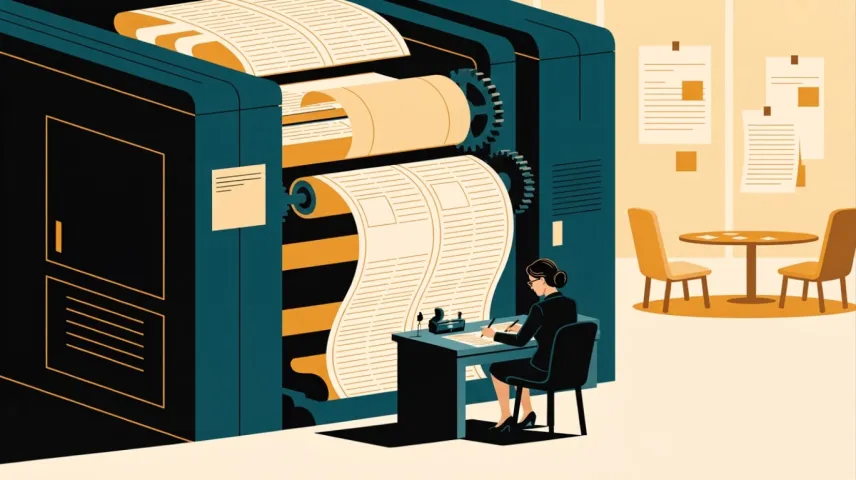
Once five reports can be produced in the time two used to take, five can quickly become the expected output. The productivity gain is real but so is the possibility that the work simply expands to fill it.
Some of the boring work is doing a useful job
Some routine work is how people learn a profession. Steenson saw this clearly in her interviews with senior lawyers. They could use AI with confidence because they already knew their trade. They had spent years doing the work themselves and had built up enough experience to recognise when an answer looked wrong. That same experience also helped them use AI more creatively because they knew enough about the law to take an idea somewhere useful. “Part of the boring work is kind of doing the reps,” she says.
Take a lawyer working through the papers on a case. Reading page after page may be laborious but spending that time with this material is also how they build an understanding of what happened and begin to notice what may matter later. By the time they reach the judgement they have already absorbed the detail behind it. “If you cut away that boring work,” Steenson says, “you can’t just parachute in.”
Griffin recognises the same problem in HR. She started at 18 writing letters, then gradually became involved in investigations and disciplinary cases. She remembers taking minutes by hand and learning the work slowly as responsibility increased. “That’s kind of how you would learn,” she says.
A junior practitioner can now “type something into Claude, get something back and think it’s true” because they don’t have enough experience to spot where it is wrong. Griffin worries about this in particular because there is also growing pressure on younger employees to demonstrate AI skills quickly.
However, her response has not been to stop junior colleagues using AI. Two administrators in her team are encouraged to use it but anything going out has to be checked with an HR business partner. They also have regular coaching sessions and the team comes together to go through what they are learning from the technology and from each other.
This creates a somewhat different apprenticeship from simply handing routine work to AI and expecting somebody to develop judgement anyway. Griffin is using the technology while deliberately keeping experienced practitioners involved in how younger colleagues learn.
Operations and technology consultant Matthew Wolff Simon has seen a similar issue in software. He began his career on technical-support phones for an internet provider before working his way through the industry and eventually leading large engineering teams. Coming from a disadvantaged background this route into the profession mattered personally too: he could learn while working and build his career from there.
He now sees junior developers getting highly convincing answers from AI before they necessarily understand enough about the underlying system to judge them properly. Some, he says, treat the technology as an “oracle”. “I do think that we have invested magical powers in something which is a token prediction engine,” he says. An experienced engineer may immediately see where apparently clean code does not fit the architecture or logic of a system. A junior is still building the knowledge needed to make that call.
Philosopher Avigail Ferdman has described workplaces that remove opportunities to develop and exercise important skills as “capacity-hostile environments”. This captures one of the main issues questions raised by AI at work: if technology increasingly does the tasks through which people once built professional judgement employers will need to think much more deliberately about where that judgement comes from instead.
Are we looking at a knowledge-work problem?
There is a limit to how far these examples can be generalised. Journalism, law, HR and software are all unusually exposed to generative AI because so much of the work involves producing language or code.
Executive coach Emma Steenson wonders whether knowledge workers are “in a little bit of a bubble”. AI may have quite a different effect in areas such as scientific research where processing huge volumes of data can achieve something people simply could not do at the same scale.
This does not make the changes in knowledge work unimportant but it does mean we should be careful about treating the experience of writers, lawyers and developers as a universal account of what AI will do to every job.
What are we choosing to automate?
Wolff Simon questions another assumption about AI at work: that the administrative parts of a job can be stripped away while the parts people value most remain untouched. Much of his career has been in software support. When somebody’s system has failed they need technical competence but they also need to feel that somebody is listening. “People still have their own basic need, which is to be listened to,” he says. As more of these interactions become automated the decision about what to hand over to AI starts to shape the job itself.
This is where I remain wary of the phrase ‘human in the loop’. It starts with the AI system and then asks where a person should be inserted into it.
Griffin has taken a different approach in her case-management system. “A human isn’t in the loop. The human owns the whole process,” she says. Workflows are designed by humans, HR practitioners make the decisions, and investigations, disciplinary hearings and difficult conversations all remain human work. AI supports the process rather than determining it.
This is important in work where somebody is responsible for the outcome. A person who appears at the end simply to approve what a system has produced may technically be ‘in the loop’ while having very little understanding of how the answer was reached. Wolff Simon has seen people formally included in a process who do little more than tick the box. They are present but they may not have done enough of the work themselves to understand how the answer was reached or to challenge it properly.
The question is where human judgement needs to sit in the work rather than where it can be added at the end.
Look at the job that remains
When I asked Wollf Simon whether AI really is making some jobs more boring he broadly agreed but then added: “I think we are collaborators in making this.”
I think he is right. AI does not decide what happens to the capacity it releases. That depends on how the job is reshaped afterwards and what people are then expected to do with the time.
If organisations want AI to leave people with better work they will need to think much harder about this redesign. Some of the time saved may be worth protecting for judgement, learning or simply spending more time with other people. Some work that looks routine may need to stay because it is where expertise is built.
Otherwise we may become very good at automating boring work while unintentionally creating more of it.
About the author