Summary and key takeaways
- AI is helping people complete tasks faster but productivity gains often disappear inside organisational friction.
- Managers, trust, decision-making and work design increasingly determine whether productivity improvements stick.
- Research from Microsoft, CMI, Investors in People and others suggests organisational factors have a greater impact on productivity than individual effort alone.
- The new productivity question for HR is whether work is designed in a way that people can perform well and create value sustainably.
- The People Space Doable Work Test offers a practical framework for identifying where productivity is leaking away.
By 6pm the workday has technically ended. In practice, though, it is often when the real work begins.
Meetings are over, emails and Teams messages have slowed and those urgent requests have been acknowledged. AI-generated summaries have been checked, rewritten and sent on. Having spent the day responding, updating, reviewing and switching between platforms you finally open the document, analysis or decision that needed your full attention hours earlier.
This is one of the contradictions inside the productivity debate. People can draft faster, search faster, summarise faster and communicate faster yet many feel busier, more interrupted and less able to do the work that creates value. The UK remains caught in a long-running productivity problem, with the Office for National Statistics estimating that output per hour worked in Q1 2026 was only 0.4% higher than a year earlier while output per worker fell by 0.1%.
The debate usually moves between the economy and the individual: GDP per hour, investment and skills on one side; performance, engagement, attendance and AI adoption on the other. The missing space is the organisation itself, where productivity either happens or leaks away.
This is the space HR should occupy. Productivity is created in the relationship between individual effort and organisational design. People still need skill, motivation, judgement and energy but the organisation decides whether those qualities are multiplied or wasted through the way work is structured, managed, measured and supported.
The new productivity question is therefore simple: are we designing work people can actually do well?
What is the new productivity question?
The new productivity question asks whether organisations are designing work in a way that allows people to perform well, think clearly and create value sustainably. It shifts attention from individual effort alone to the systems, priorities, tools, meetings, decision rights, management practices and trust conditions that shape performance. But before asking people to do more, leaders need to ask whether work gives them a fair chance of doing it well.
This question has become more urgent because the old productivity assumptions are under strain. At last week’s CIPD Festival of Work FT columnist and economist Tim Harford reminded the audience that productivity is ultimately output for input. This definition is simple but the reality of modern work is not.
What counts as input in knowledge work: hours, attention, energy, expertise, technology or managerial time? What counts as output: messages sent, meetings attended, customer problems solved, better decisions made, risks avoided or value created? If leaders cannot define the output that matters they will struggle to know whether AI, hybrid work, office attendance, collaboration or performance management is improving productivity at all.
The AI productivity puzzle
The promise of AI has sharpened the productivity question. Some people are already moving faster with better tools while wider economic gains remain uneven and hard to read. In May 2026 the San Francisco Fed noted that recent labour productivity gains and rising business investment in AI had raised the question of whether the economy was entering a period of higher productivity growth, but warned that two well-known productivity measures did not yet provide strong evidence of that shift. The echo of Robert Solow’s 1987 observation is hard to miss: “You can see the computer age everywhere but in the productivity statistics.”
Microsoft’s 2026 Work Trend Index puts the issue in organisational terms. Its foreword, written by Harvard Business School professor Dr Karim Lakhani, asks: “How should work itself be designed when intelligence can be embedded, distributed and increasingly delegated?” The report also warns: “Productivity gains at the edge do not automatically become enterprise transformation at the core.”
Gary Hamel, visiting professor at London Business School, makes the same point more bluntly. Despite huge spending on IT since the early 2000s, he argues, most corporations still use new technologies in incremental ways. “Put simply, there’s only so much you can get out of a new technology when your goal is to pave the cowpath,” he said.
This is the productivity trap. AI may help an employee write, analyse or summarise faster while the organisation around them continues to run on old metrics, old approval routes and old assumptions about what good work looks like. Microsoft’s research, based on 20,000 AI users across 10 countries and anonymised Microsoft 365 productivity signals, found that “people are ready. The systems around them are not”. Organisational factors such as culture, manager support and talent practices accounted for more than twice the reported AI impact of individual factors such as mindset and behaviour.
Only 26% of AI users in Microsoft’s survey said their leadership was clearly and consistently aligned on AI. Some 65% feared falling behind if they did not adapt quickly while 45% said it felt safer to focus on current goals than to redesign work with AI. Employees feel pressure to move faster while the organisation still rewards the old rhythms.

The work around the work
The modern productivity problem often looks like ordinary work. We’ve all sent that message to check whether an email has been seen or used AI to quickly draft a presentation, which must then be reviewed by three people as no one has agreed what good looks like. And we all recognise that managers are pulled between performance, wellbeing, transformation, recruitment, cost control and employee relations, with no reduction in the demands landing on their own desk.
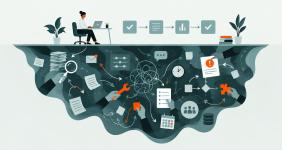
Together these examples become the work around the work: the coordination, checking, waiting, translating, smoothing and reworking that fills the day while the higher-value work is pushed to the edges. This is where productivity often leaks away, through the accumulation of unclear priorities, excessive collaboration and fragmented attention.
Technology can add to the problem when it is layered onto existing processes without changing the work underneath. AI may produce a draft in seconds but if the organisation has no shared standards for quality, accountability or decision-making the time saved at the first stage can reappear as review, checking, rework or risk management elsewhere.
The Chartered Management Institute’s latest research illustrates this gap. While 70% of UK managers report some productivity improvement from AI, only 5% say the gains have been transformational and more than a quarter say they have seen no productivity gains at all.
The management layer is central because managers are where productivity ambitions meet the real working day. Managers are expected to translate strategy into priorities, help people adopt AI, protect wellbeing, hold performance standards, manage change and keep delivery moving. Yet the CMI research found only 12% of managers feel very confident managing AI-enabled teams, falling to 10% for advanced agentic AI systems. Jacky Wright, former chief technology and platforms officer at McKinsey and chair of the CMI AI Advisory Council, puts it plainly: “AI adoption is not just a technical challenge, it is a management challenge.”
This is where productivity becomes a work design question. Skilled people can still be slowed by unclear priorities, motivated people can still be exhausted by excessive coordination and managers can still struggle when the organisation keeps adding expectations without removing friction. AI can help, but only if leaders use it to rethink the work itself rather than accelerate badly designed processes.
Low trust is a productivity drain
Trust adds another layer. It is easy to treat trust as a culture measure yet its productivity impact shows up in behaviour. Research from Investors in People finds that 61% of employees regularly “cover themselves” at work, for example by keeping emails or screenshots, while 65% have avoided raising or speaking openly about something at work in the past six months.
Eddie Salmon, chief operating officer at Investors in People, puts it bluntly: “Britain’s productivity debate is missing one of the issues sitting in plain sight: trust.”
His point is that low trust diverts energy. “If employees do not trust their leaders or their organisation they spend time and energy protecting themselves instead of solving problems, improving work and taking initiative,” he says.
The organisation may still look busy but part of its energy is being used to defend against itself. Problems surface later, mistakes stay hidden and improvement slows. Productivity cannot be reduced to motivation, focus or effort when the organisation has made productive work harder than it needs to be.
This is why HR needs to lead the middle ground. Finance sees productivity in the numbers, IT provides the tools and operations redesigns processes but it’s HR that connects the human and organisational conditions that determine whether effort becomes value: jobs, teams, skills, trust, culture, management, incentives, wellbeing and work design.
The 2026 anthology The Age of HR points in the same direction. Outgoing CIPD chief Peter Cheese links productivity stagnation to rigid work patterns, hierarchical organisational models, command-and-control cultures, stress, fairness concerns and work-life balance.
Labcorp EVP, CHRO Anita Graham and Utah State University management scholar Mike Ulrich argue that HR must move from activity metrics to impact, including productivity, customer satisfaction, revenue and cost. Professor of HRM Chris Collins connects employee experience with meaningful work, autonomy, manager behaviour, work design, tools and wellbeing.
At the Festival of Work incoming CIPD chief executive Neil Carberry made the economic version of the argument. HR’s role, he said, is to help organisations deliver performance and productivity. He linked better people strategies to a potential £60bn annual gain for the UK economy and described the country as locked in a cycle of low growth that creates fiscal problems and holds the economy back.
This is a larger mandate than HR has sometimes claimed for itself. Productivity should sit with HR because work design is people strategy in practice. It is where capability, behaviour, culture and organisation design become business value.
What makes work doable?
Work is doable when people have the clarity, resources, authority, trust and recovery time needed to create value. High-value work is often complex, demanding and uncertain but the demands need to be matched by the resources and authority people need to meet them.
A senior team that wants more innovation while punishing failed experiments, a business that wants faster decisions while requiring too many approvals, an organisation that introduces AI without changing workflows or a leadership team that asks managers to improve engagement, productivity, wellbeing, performance and change adoption without reducing other demands have created a design problem.
The work may still get done but at a cost: longer hours, hidden stress, lower trust, reduced learning, slower decisions and wasted effort.
The People Space analysis suggests productivity is increasingly determined by whether work is designed in a way that people can actually do well.
The People Space Doable Work Test
HR leaders need a practical way to examine whether productivity problems are being designed into work itself. The People Space Doable Work Test asks eight questions:
- Is the valuable output clear?
- Are priorities explicit enough for people to make trade-offs?
- Do people have enough uninterrupted time for high-value work?
- Are meetings, messages and approvals proportionate to the value being created?
- Are decision rights clear and close enough to the work?
- Does technology remove work, move work or create work?
- Is trust high enough for problems, mistakes and risks to surface early?
- Is the workload sustainable without routine spillover into evenings and weekends?
This test moves the productivity conversation away from vague exhortations to “do more” and towards the actual conditions of work. It also gives HR a more practical starting point: audit work before auditing performance, map the employee day as well as the employee journey, treat meetings as an organisational design issue, clarify decision rights and use AI implementation as a trigger to remove, simplify or redesign work.
The point is to make accountability more honest. People should be expected to contribute, learn and perform. Organisations should be expected to design work so that contribution, learning and performance are possible.
Before asking people to produce more, leaders need to ask whether work is clear enough, trusted enough, focused enough and well designed enough for people to do it well. This may be one of the most practical productivity questions organisations can ask.
FAQ on work design
What is work design?
Work design is the way tasks, roles, responsibilities, decision rights, tools, meetings and working patterns are structured to enable performance.
Why is productivity a work design issue?
Productivity depends on whether people have the clarity, time, resources, authority and trust needed to create value. Poorly designed work creates friction, distraction and waste.
How can HR improve productivity through work design?
HR can audit workload, collaboration load, meeting culture, manager capacity, decision rights, trust behaviours and technology use to identify where the organisation is making work harder than it needs to be.
About the author