10-minute watch
Imagine a 45% share price performance differential against your own sector peers. Now that is something any leader would want, especially in today’s age where corporate value is created and lost at breathtaking speed.
Well, says professor Stephen Wyatt, his research shows that this can be achieved. It’s all about dynamic capacity: an organisation’s ability to be adaptive and pursue a consistent winning and motivating strategy key to Fourth Industrial era success. Or as Wyatt himself puts it: “The measure of the ability of an organisation to adapt to the future as it unfolds, but also to influence the unfolding of that future.”
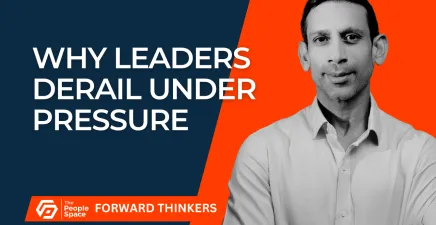
In this video Wyatt explains what the Fourth Industrial age is, why leadership, not technology, is key to success at this time and how dynamic capacity is a tool to predict future performance.
For more, why not check out Wyatt’s 4-minute read on the nine leadership traits driving business success in the Fourth Industrial Revolution.
About Stephen Wyatt
Stephen Wyatt is professor of strategy and leadership at the University of Bath. For over 25 years he has worked as a business consultant focusing on developing leader and enabling organisations to thrive in highly dynamic environments. He is also affiliate faculty and Singapore Management University and industrial associate at the University of Cambridge. Wyatt serves on the boards of the Global Innovation Management Institute and the Management Consulting Institute. He is author of Management and Leadership in the 4th Industrial Revolution.
Transcript
A definition of the Fourth Industrial Revolution
Every industrial revolution is a period of profound societal change and driving that, or part of that, is how businesses operate - and how businesses operate and societal change are usually enabled by some shift in technology or management practices.
So the Fourth Industrial Revolution is, if you look at the technologies around, that's all the things like AI, machine learning, nanotech, all the biotech advances that are coming through. And so that's enabling a lot of people to reimagine their business models, what they're doing, how they operate, where they work - as we know a lot of people working remotely enabled by digital communications and so forth. And it's the opportunity to, as we think about changing how we work and what we work on and the use technology, can we address some of the major societal issues, obviously sustainability, the wealth gap and soon.
So the Fourth Industrial Revolution is the one that we're in now. It's ongoing. It doesn't happen overnight. It's not like switching on a switch or switching off a switch. It's a rolling thing but it's getting momentum and we've probably been seeing the changes for about the last seven or eight years. And it's just gathering pace and gathering momentum.
So in any industrial revolution, but let's say particularly in the Fourth, the adoption of the technologies that are coming through or available are part of the process. They are enablers. But it's really what the leadership does with those technologies that really matters. So you can, the old expression, you can digitise the cow paths or you can just reinvent how the company operates and see new possibilities because of the adoption of technology.
The fourth Industrial Revolution is about leadership, not technology
In the Fourth Industrial Revolution in particular is the speed of evolution of technology. So, you could adopt a technology or deploy a technology today and think that you've done your transformation. You've done your digital transformation, as the old expression used to go. But it's probably going to be obsolete in about 18 months’ time and you'll have to do something else. So the attitude that needs to change is not a one- time fix of adopting some technology. It's a mental state that the leadership needs, which is leaning forward and leaning in. And so looking ahead.
And then you're deploying the technologies as they come available, or even creating the technology that you need to succeed. But you don't do it as a 'we've plugged and played with somebody else's technology and that's how somehow fixed ourorganisation.'
So leadership is the part that really makes a big difference on the success of the company. And that leadership has to lean in and take advantage of the changes or the technology changes that are happening, but really it's about how you engage the talent. And so that's a leadership issue.
So I give you a very simple example on that. It is estimated that there are a million job vacancies in the UK for people with data analytics skills. So I use that number just to get it out there, but you just think how long it would take to train a million people through traditional approaches of university and so forth.
And so the answer is we clearly can't just supply new talent fast enough - the talent that's required to really thrive in the Fourth Industrial Revolution. So what we really needed is to think about our existing workforces and how to redeploy them. And sure there's some upskilling and reskilling that's required in the flow of work at speed, on mass, but it's the leadership that's really going to be leaning into the future and saying, well, what can we do in order to compete in this new world that is unfolding, the speed of business that's going up, with our existing resources and adoption of technology. So leadership's the critical part. Talent management's the critical part. Technology is absolutely an enabler but it's less ofa differentiator.
What is dynamic capacity?
So dynamic capacity is a measure of the ability of an organisation to adapt to the future as it unfolds but also to be influencing the unfolding of that future. And so it's how adaptable are we? How quickly can we do that? Can we make theright choices?
So the analogy I use oftentimes is that of a tennis player at the top of their game. And so in order that the tennis player can play - and a tennis player at the top of their game is able to play in a very fast game, right? When you're an amateur you play a very slow game, or just beginning you play a very slow game and make lots of mistakes. But as a professional, you're playing in a very fast game and that's an analogy for how business is just going faster and faster because of the speed of evolution and technology adaptation that's possible, the disruptions that we're finding. So we need to play at the top ofour game.
And how does a tennis player do that? Well effectively they've got a great sensory mechanism. So they can sense and almost predict where the ball from their opponent is going to go. And some of that's, of course, through great analysis and so forth of what a player's done, the opponent's done, historically. We only have data on the past. But then you're looking to be anticipatory. Where's the ball going to go? Where is that player going to hit the ball? And so you're looking at the minor signals, the weak signals, for example maybe the body language or the body positioning of the opponent, where their eyesare looking - you get very precise signals from that. And so what you are doing is enhancing your sensory perception. And that is the same in businesses. If we're going to be playing in the Fourth Industrial Revolution at speed, we need to have greatsensory perception.
And then the second thing is if you can sense or make sense of what's happening or going to happen, then you need to do something about it. So you need to seize on the opportunities that are unfolding. Again, the analogy would be you don't wait for the ball to be beside you in your court before you figure out how to hit it back. You're thinking about hitting it back before it's arrived. What's your play going to be? You may be even adjusting yourself in order to get to the right place.
And so, in a business context, you want to be, again, anticipatory in your preparation of your solutions, such that when the timing is correct, the ball arrives, the events unfold, you can launch your new business model and your new offering, whatever it happens to be. So, I talk about that as a seizing and then being able to replicate that.
And then the third capability that sort of fits into that is of course your ability to move around the court. And in a business context that would be what assets you've got inside your organisation, how you're collaborating externally to accessresources and so forth, and your positioning of your offering. So there's reconfiguring and repositioning. So these are the three capabilities that need to come together.
Dynamic capacity pays
And the research that I did looked at these capabilities and found ways to actually measure their strength in an organisation. And if you measure the strength of these three sets of capabilities, it turns out there's a multiplication relationship betweenthem. So essentially you measure index one, two and three, you multiply them together, and that gives the index or the measure of dynamic capacity; the ability of the firm to act dynamically or to adjust in appropriate ways as the future unfolds. And so I did this with inputs from about 80 organisations, quite large corporations and all those companies were withmultinational, with international operations.
And so then we tracked the share price of those companies against their own sector peers. So not against each other, because they were all from different sectors and from around the world, but their own sector peers. If it was alcohol from a French company you look for other alcohol companies and so forth.
And we found that those companies that had this index, this dynamic capacity index, which was higher than the average for our sample of 80, and we tracked them. And on average they outperformed their own sector peers, their share price outperformed their own sector peers, by just over 30% - 31% - over a five-year period of time.
And similarly, those firms in our survey, which had below average dynamic capacity, we tracked their share price performance against their sector peers and they underperformed their sector peers by about 15%.
So it basically says the dynamic capacity index, whether you're below or above average, could represent a 40 plus, 45%, performance differential against your own sector peers. And that was over five-year period of time that we looked at that. And so it showed a couple of things: dynamic capacity as an index is a leading indicator, a forward indicator, of how well your company's going to do. And there are very few forward indicators available for investors or whatever. And secondly, if you work on those aspects of dynamic capacity, you can enhance the performance of your firm. So, that's a very practical,pragmatic set of tools.
About the author