Key insight
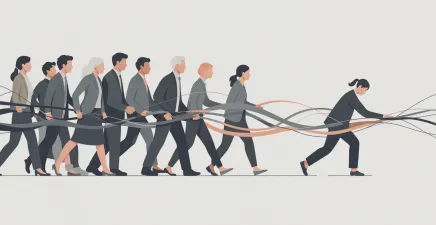
Change fails when organisations treat people as predictable project variables rather than human beings navigating loss, uncertainty, and identity disruption. Emotion is not resistance. It is data.
Why organisational change fails when emotion is ignored
We’ve all seen the pattern. A transformation launches with executive fanfare, detailed roadmaps and expensive consultancy support. Months later, it stalls. Engagement drops. Key people leave.
When a post-mortem happens at all, it usually focuses on execution failures, weak sponsorship, poor communication or insufficient resources. What rarely gets named is the real issue: change is designed as if people were predictable variables, not human beings navigating uncertainty, loss and disruption to identity and belonging.
Most organisational change fails not because the strategy was wrong but because leaders systematically ignore how people feel. We obsess over process, timelines and delivery metrics while treating emotion as an inconvenient distraction rather than something to be understood and worked with. This is a fundamental error, costing organisations billions in failed implementations, lost productivity and talent attrition.
Leading change is an intensely emotional experience for everyone involved, from executives to frontline employees. Yet emotion is rarely discussed openly, almost never planned for strategically and frequently dismissed as resistance rather than recognised as valuable information about what is really happening. In an era of continuous disruption this blind spot is becoming existential.
HR is uniquely positioned to address this. Not because HR has a monopoly on empathy but because it understands human systems, hears what goes unsaid and has access to conversations at every level. The question is whether HR will step into this space with clarity and courage, or continue to collude with the fiction that change is primarily a technical challenge.
What actually happens to people during organisational change
When organisations announce restructures, mergers, new operating models or AI-enabled ways of working, they are not simply changing reporting lines or tools. They are asking people to let go of relationships, competencies, routines and identities that may have taken years to build. At the same time they activate threat responses in the brain while asking for trust.
This is profoundly destabilising. People respond with anxiety, anger, scepticism or withdrawal – reactions leaders often label as resistance rather than recognising them as rational responses to feeling unheard or disrespected.
These reactions are not character flaws or signs of poor resilience. They are normal human responses to uncertainty and loss. The problem is that traditional change models, with their neat stages and linear progressions, assume change has a clear beginning, middle and end. They assume that with enough communication and training people will adapt.
We no longer live in a world of stable change. Asking people to “get through” change and return to normal is a fantasy. The real challenge is learning to function amid ongoing ambiguity while preserving psychological safety, trust, and purpose. Linear models and one-way communication fail here. When leaders say “trust the process,” employees often hear that their emotions are inconvenient. The result is emotional labour that erodes engagement and drives talent away.
Why trust breaks down during transformation programmes
Trust is the foundation of successful change, yet it is often the first casualty of how transformation programmes are led. The integrity gap between what leaders say and what employees experience becomes a chasm that no amount of town halls or intranet updates can bridge.
Consider what typically happens. Leaders announce that the change is about "empowering our people" or "investing in our future," while simultaneously making redundancies, increasing workloads or imposing new systems without meaningful consultation. They talk about psychological safety while punishing those who raise concerns. They claim transparency while withholding information about who will be affected, when decisions will be made or what the real drivers of the change are actually. They ask for feedback through surveys and focus groups, then proceed exactly as planned, signalling that employee input was performative rather than genuine.
Each of these moments is an integrity failure, a disconnect between espoused values and lived experience. Employees notice. They track the gap between the inspirational narrative and the messy reality. They see which behaviours get rewarded, whose concerns get dismissed, who gets protected and who gets sacrificed. As a result they draw conclusions about whether leadership can be trusted to tell the truth, to act with fairness or to prioritise people alongside performance.
Once trust is broken everything becomes harder. The emotional climate shifts from cautious optimism to defensive disengagement and the change effort enters a spiral of declining participation and rising resistance.
Rebuilding trust is possible but it requires leaders to do something deeply uncomfortable: acknowledge integrity failures, own their impact and demonstrate through consistent behaviour that things will be different.
This is where HR becomes critical – not as enforcers of the change programme but as custodians of the psychological contract and organisational integrity.
What role HR should play in emotionally intelligent change
HR’s opportunity is not to run change more efficiently using the same playbook but to fundamentally reset how organisations approach transformation. That requires a shift in role – from implementer to conscience, coach and custodian of trust.
What HR must do differently during organisational change
Read emotional signals, not just data
Engagement scores and attrition rates are trailing indicators. By the time metrics show a problem, psychological safety has already eroded. HR must listen for emotional undercurrents through skip-level conversations, informal check-ins, patterns of silence, gallows humour or spikes in sickness absence – and bring these insights to leadership early.
Coach line managers to hold emotional load
Frontline and middle managers absorb the emotional weight of change while managing their own uncertainty. They need coaching on sitting with discomfort, having honest conversations about unknowns, creating stability where possible and modelling vulnerability that makes it safe for others to acknowledge struggle.
Reset expectations of what good change leadership looks like
The myth that strong leaders must appear perpetually calm is damaging. Performing certainty when none exists erodes trust. Leaders who acknowledge emotion and say “I don’t have all the answers yet” create permission for honesty across the organisation.
Create spaces for processing change, not just communicating it
Most change communication is one-way. What’s needed are structured opportunities for people to make sense of change together, voice concerns without retribution and reflect with peers. The goal is not forced positivity but preventing emotional suppression from hardening into cynicism or burnout.
Challenge false urgency
Speed is sometimes necessary but often urgency is artificial – driven by impatience or a desire to “get the pain over with.” Moving too fast denies people time to grieve what’s ending and meaningfully engage with what’s emerging. HR must ask what is truly driving the timeline, and what is being sacrificed by moving at this pace.
How to lead change with emotional intelligence and delivery discipline
Bringing emotion into change leadership does not mean abandoning rigour. It means expanding what rigour looks like.
- Before announcing change, map the emotional landscape. Identify who will experience loss, threat, relief or opportunity, and why. Use this insight to shape timing, messaging and support.
- Design narratives around truth, not spin. Be honest about drivers, risks, unknowns and trade-offs. Acknowledge losses as well as gains without overselling the future.
- Slow the start to build trust. Create genuine dialogue before implementation and show how input has influenced decisions.
- Equip managers to lead through vulnerability. Give them tools for difficult conversations and permission to say: “I don’t know.”
- Build reflection points into the process, not just milestones. Pause regularly to assess how people are coping and adjust course early.
- Make space for grief. Mark endings with respect through rituals that honour what is being left behind.
- Track emotional indicators alongside operational ones, and treat declines seriously.
- Model the behaviour you want to see. Culture is shaped by what leaders reward and tolerate, not by what they say.
- Plan for the long tail. Emotional adaptation continues long after go-live. Do not declare victory too soon.
- Celebrate learning as well as outcomes. In continuous change, adaptive capacity matters as much as delivery.
What organisations must do to change humanely and sustainably
Organisations can no longer afford to treat emotion as peripheral. Ignoring it leads to failed change, damaged relationships, and sustained talent loss. Pretending people are rational actors who will comply if given enough information is a costly delusion.
HR has a choice. Continue as implementer, absorbing the fallout of decisions made elsewhere. Or step into a more powerful role as the organisation’s emotional intelligence – insisting on humanity, integrity and trust as non-negotiable elements of change.
This will not always be comfortable. It requires slowing down when pressure mounts and naming integrity failures when silence feels safer. Yet it is one of the most strategically valuable contributions HR can make in a world where the ability to change well is a defining advantage.
The organisations that thrive will not be those that change fastest but those that change most humanely – treating emotion as valuable information rather than noise to suppress.
Emotion is not the enemy of effective change. It is the missing variable. And HR is best placed to bring it back.
About the author